Your employees need access to business systems, applications, and data to do their jobs. But how do you make sure the right people have the right access without creating unnecessary security risks?
As your organization grows, managing digital identities becomes more complicated. Employees work remotely, applications move to the cloud, and external partners need access to selected systems.
Identity and access management (IAM) helps you control that access, protect sensitive information, and maintain oversight of who can use your business resources.
Table of contents
What Is Identity and Access Management?
Why Is Identity and Access Management Important for Businesses?
What Are the Most Common Identity Security Risks?
Which Are the Core Components of Identity and Access Management?
What Are the Business Benefits of Identity and Access Management?
How Is Identity and Access Management Used Across Different Industries?
What to Look for in an Identity and Access Management Partner

What Is Identity and Access Management?
Identity and access management (IAM) is a framework of policies, processes, and technologies that verifies digital identities and controls access to business systems, applications, and data.
It establishes who someone is, what they can access, and under what circumstances.
Traditionally, you might have concentrated on protecting your networks and devices. Today, your employees, contractors, and partners access information from different locations, using multiple devices and cloud applications.
You can no longer rely on your network perimeter to protect your organization. You need to secure the identities of those accessing your resources, wherever those resources are located.
Effective identity management gives you centralized oversight of user identities, while access management determines which resources each identity can use.
Together, these provide an essential foundation for modern cybersecurity and Zero Trust security strategies.

Why Is Identity and Access Management Important for Businesses?
As your organization adopts more cloud applications, supports hybrid working, and expands its relationships with third-party providers, you create and need to manage more identities and access permissions.
For example, every new employee, application, or external partner introduces another access decision.
Without a coordinated identity security strategy, permissions can accumulate and accounts may remain active after employees leave. You can gradually lose visibility into who has access to sensitive information.
What Are the Most Common Identity Security Risks?
Some of your greatest security risks involve legitimate accounts that attackers compromise or users re
tain unnecessarily. For example:
- Compromised credentials. Weak passwords, phishing, and stolen login information can give attackers access to business systems.
- Excessive permissions. Employees and contractors may retain access to information or applications they no longer need.
- Shared and inactive accounts. Shared credentials reduce accountability, while former employees’ accounts can create unnecessary exposure.
- Uncontrolled external access. Third-party vendors and unauthorized applications can introduce additional identity risks.
These problems become harder to identify when different departments manage access independently.
An identity and access management framework helps you establish consistent access policies, verify users, review permissions, and identify suspicious activity.
It also supports your wider cybersecurity strategy by reducing opportunities for unauthorized access and limiting the potential consequences of compromised accounts.

What Are the Core Components of Identity and Access Management?
Effective IAM solutions combine several security measures. Each addresses a different aspect of identity verification, access control, or ongoing identity governance.
How Do You Verify Identities and Control Access?
Multi-factor authentication (MFA) requires users to provide additional verification beyond a password. This makes stolen passwords less useful to attackers, although the strength of protection depends on the authentication method.
Passwordless authentication replaces traditional passwords with alternative methods, such as passkeys or biometric verification. Depending on the method, it can reduce password-related risks and simplify the login experience.
Single sign-on (SSO) allows employees to access multiple authorized applications through one authentication process. It can reduce password fatigue and simplify centralized access management.
Conditional Access evaluates factors such as user identity, device security, location, and risk before allowing access. Your organization can apply additional verification or block access when conditions warrant it.
How Do You Manage User Permissions Throughout Employment?
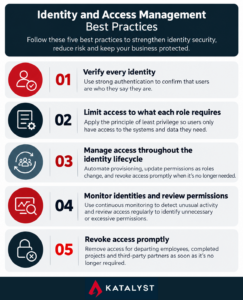
Role-based access control (RBAC) assigns permissions according to job responsibilities. Employees receive the access they need without automatically gaining access to unrelated systems.
Identity lifecycle management controls user access from onboarding through role changes and departure. Automated user provisioning and deprovisioning help your organization grant, update, and revoke permissions promptly.
Privileged access management (PAM) applies additional controls to accounts with elevated permissions, such as system administrators. These accounts require particular attention because their misuse can have extensive consequences.
How Do You Monitor and Protect User Identities?
IAM requires ongoing oversight.
Identity monitoring helps your security team detect unusual login activity, investigate potential account compromise, and identify access patterns that require attention.
Regular access reviews also help you identify unnecessary permissions, inactive accounts, and exceptions to your security policies.
Together, these measures strengthen identity governance and support a Zero Trust approach, where access decisions depend on continuous verification rather than assumed trust.

What Are the Business Benefits of Identity and Access Management?
A well-managed IAM strategy delivers benefits to your business beyond stronger authentication.
Stronger cybersecurity: Consistent identity verification and access controls reduce opportunities for unauthorized access. Restricting permissions can also limit the damage caused by compromised accounts and certain ransomware attacks.
Improved compliance: Documented access policies, monitoring, and regular reviews help you demonstrate how your organization protects sensitive information and manages access to regulated systems. This applies as much for governance compliance as for cybersecurity insurance requirements.
Greater operational efficiency: Centralized identity management simplifies administration across multiple applications and business locations.
Faster onboarding and offboarding: Automated processes help new employees access the resources they need while ensuring departing employees lose access promptly.
Better visibility and accountability: You gain a clearer picture of who can access critical business resources, making it easier to identify unnecessary permissions and investigate security incidents.
These benefits depend on effective policies and ongoing management. Deploying authentication technology will not resolve inconsistent access practices on its own!

How Is Identity and Access Management Used Across Different Industries?
Every organization needs to protect digital identities, but your industry’s operational requirements influence how you implement IAM.
Healthcare
Healthcare organizations must protect sensitive patient information while giving authorized clinical and administrative staff timely access to essential systems.
Identity and access management for healthcare helps you control access according to responsibilities, maintain accountability, and support compliance with applicable healthcare privacy and security requirements.
Manufacturing
Manufacturers increasingly connect production systems with business applications and external service providers.
Identity management for manufacturing helps control employee and vendor access to these environments. Restricting permissions can reduce exposure without unnecessarily disrupting production or maintenance.
One North Carolina-based food manufacturer’s IT Director said:
“Katalyst did a great job on the security assessment, and they have very knowledgeable people. Be ready to discuss what you have, and talk through everything in depth, because they’re going to cover it all.”
Financial Services
Financial institutions manage sensitive customer information and transactions under demanding security and regulatory requirements.
IAM supports stronger authentication, separation of duties, privileged access controls, and the access records needed for oversight.
Local Government
Local government departments often operate multiple systems serving different public functions.
Centralized identity management can help you apply consistent security policies while controlling access to confidential records and essential public services.
Professional Services
Professional services firms frequently collaborate with clients, contractors, and external partners.
IAM helps you provide appropriate access to shared applications and confidential information while withdrawing permissions when projects or contractual relationships end.
What to Look for in an Identity and Access Management Partner
Choosing an IAM solution involves more than selecting authentication software. You need a governance strategy that reflects your business operations, security requirements, existing technology, and plans for growth.
An experienced provider of identity and access management services should begin by assessing your current environment. That includes:
- identifying critical applications,
- reviewing user permissions,
- examining privileged accounts, and
- evaluating existing access policies.
Your partner should also help you establish an identity and access management framework that addresses governance, compliance obligations, and operational requirements.
Look for expertise in cloud identity management, integration with your existing systems, and technologies such as Microsoft Entra ID where appropriate.
Implementation is only the beginning.
Your IAM strategy needs regular access reviews, identity monitoring, policy updates, and employee training to remain effective as your organization changes.
Identity and access management consulting can help you identify priorities, while ongoing managed identity security services provide the oversight needed to maintain those controls.
Identity Security As Part of Your Business Strategy
As your organization grows, so does the number of identities accessing its systems and information.
Effective identity and access management gives you greater control over those identities, supports compliance, and strengthens your wider cybersecurity strategy. It also provides an important foundation for Zero Trust security.
Strengthen Your Identity and Access Management Strategy with Katalyst
Katalyst helps organizations across the Carolinas and beyond evaluate their security requirements and develop strategies that support their business objectives.
Whether you need an identity security assessment, guidance on identity governance, or ongoing managed cybersecurity services, our team can help you identify your next steps.
Speak to one of our experts to discuss your identity security strategy.
Throughout October, Steve Rattacasa is hosting live sessions with industry expert guest speakers to discuss threats and cyber-trends shaping how our clients protect themselves. You can save your seat here.