HIPAA-compliant IT services have become an essential part of protecting patient data, maintaining business continuity, and reducing operational risk. If your healthcare organization treats HIPAA compliance as an annual exercise, you’re already behind.
Cyber threats, regulatory expectations, third-party vendors, and cloud platforms constantly evolve, so your compliance strategy must keep pace.
This guide explains what HIPAA-compliant managed IT services include, how they support healthcare cybersecurity and regulatory compliance, the risks that commonly lead to HIPAA violations, and what to look for when choosing a trusted managed IT partner.
Whether you lead a physician group, multi-location practice, or larger healthcare organization, the right approach to healthcare cybersecurity helps reduce risk by strengthening compliance. It also protects patient trust – a crucial healthcare goal.
Table of contents
Why HIPAA Compliance and Secure Medical Networks Are No Longer Just an IT Responsibility
What Are HIPAA-Compliant IT Services?
How Managed IT Helps Your Healthcare Organization Stay HIPAA Compliant
What Are Common Healthcare IT Risks That Lead to HIPAA Violations?
Benefits of Partnering with a HIPAA-Compliant IT Provider
How to Choose a HIPAA-Compliant Managed Service Provider
Building a More Secure and Compliant Healthcare Organization

H2: Why HIPAA Compliance and Secure Medical Networks Are No Longer Just an IT Responsibility
HIPAA compliance used to belong largely with IT teams and compliance officers. Today, HIPAA compliance influences every aspect of your healthcare infrastructure management.
Executive leaders now face growing pressure to protect patient data, maintain uninterrupted care, satisfy regulators, and demonstrate that appropriate safeguards remain in place throughout the year.
That’s a daunting task for any organization.
Your clinical operations depend on immediate access to electronic health records, connected medical devices, and digital communications.
A successful attack can interrupt patient care, disrupt revenue, delay treatment, and damage the reputation your organization has spent years building.
And that’s precisely why ransomware attacks continue to target healthcare.
Regulatory expectations continue to evolve. The Office for Civil Rights (OCR) investigates data breaches and complaints, while cyber insurers increasingly expect you to demonstrate strong cybersecurity controls before providing or renewing coverage.
Third-party vendors, cloud platforms, and business associates add further complexity because every connection to your systems introduces another potential point of failure.
H3: Why Healthcare Cybersecurity and HIPAA Compliance Go Hand in Hand
HIPAA compliance defines what your healthcare organization must protect, while healthcare cybersecurity provides the controls that make that protection possible.
One establishes the standard; the other helps you achieve it every day.
We’ve found that organizations make the greatest progress when they stop treating healthcare data protection and compliance as an annual exercise and instead build it into everyday operations.
Graystone Eye discovered this through a co-managed infrastructure agreement with Katalyst: “There was no sales team looking for opportunities to take advantage of our vulnerable situation – just a partner willing to support us.”
–Ted Bayack, Director of IT at Graystone Eye
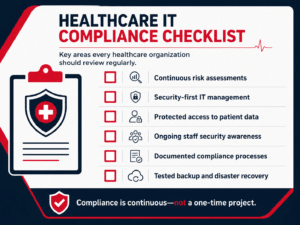
Continuous monitoring, regular risk assessments, staff awareness, documented processes, and layered security reduce compliance risk while strengthening your operational resilience.
It only takes one data breach splashed across social media to erode patient trust and undermine your business.
For leadership teams, HIPAA compliance supports both patient trust and business continuity.
H2: What HIPAA-Compliant IT Services Actually Include
H3: What Are HIPAA-Compliant IT Services?
HIPAA-compliant IT services combine technology, cybersecurity, and compliance practices to help you protect patient data, reduce operational risk, and meet HIPAA requirements.
Rather than responding after incidents occur, managed IT for healthcare continuously works to strengthen your security posture, document compliance activities, and reduce the likelihood of disruption.
A comprehensive HIPAA-compliant managed IT service typically includes:
- 24/7 monitoring and rapid incident response
- Endpoint protection for computers, mobile devices, and connected medical technology
- Network security and secure medical networks
- Identity and access management, including multi-factor authentication
- Healthcare cloud security and secure cloud environments
- Email security to reduce phishing and malware attacks
- Security awareness training for employees
- Backup, disaster recovery, and business continuity planning
- Vulnerability management and routine security updates
- Compliance reporting, risk assessments, and supporting documentation
Basic IT support focuses on fixing technical problems after they occur.
Managed IT services add proactive monitoring and ongoing technology management.
HIPAA-compliant managed IT services go further by aligning every aspect of IT management with healthcare cybersecurity, regulatory requirements, and the protection of electronic health records and other sensitive patient information.
In our healthcare compliance consulting, we’ve seen that organizations often assume compliance comes from installing the right technology. In reality, technology is only part of the picture.
You need to combine secure systems with continuous oversight, documented processes, and experienced guidance to keep your healthcare organization secure throughout the year.

H2: How Managed IT Helps Your Healthcare Organization Stay HIPAA Compliant
H3: How Do Healthcare Organizations Stay HIPAA Compliant?
Healthcare organizations stay HIPAA compliant by combining administrative, technical, and physical safeguards with ongoing oversight. Compliance depends on consistently managing risk, protecting patient information, documenting security activities, and adapting to new threats as your organization evolves.
A HIPAA-compliant managed IT provider helps turn those requirements into everyday practice.
Administrative safeguards include regular risk assessments, security policies, employee training, and Business Associate Agreements (BAAs) with vendors that handle protected health information.
Technical safeguards focus on protecting systems through secure access controls, encryption, monitoring, and vulnerability management.
Physical safeguards help secure the devices, facilities, and environments where patient information is accessed or stored.
We’ve found that documentation is often where organizations struggle. It’s time-consuming. But even when appropriate security controls exist, they need to be reviewed, recorded, and supported with evidence.
Risk assessments, policy updates, incident response plans, and compliance reporting all contribute to demonstrating that your organization takes HIPAA obligations seriously.
Rather than preparing for compliance only when an audit approaches, proactive managed IT services help you stay ready throughout the year.
Managed IT for healthcare reduces risk and strengthens your operational resilience. Your leadership can then focus purely on delivering high-quality patient care.

H2: What Are Common Healthcare IT Risks That Lead to HIPAA Violations?
Many HIPAA violations result from everyday weaknesses rather than sophisticated cyberattacks. A missed software update, excessive user permissions, an employee responding to a phishing email, or an unsecured laptop can expose sensitive patient information and trigger significant operational and regulatory consequences.
H3: Where Most Healthcare Organizations Become Vulnerable
Not every data breach begins with an external attacker.
For example, in healthcare, there’s always the temptation for employees to access the medical records of family members, colleagues, or high-profile patients without a legitimate business reason.
Strong identity and access management, audit trails, continuous monitoring, and regular staff training help prevent curiosity from becoming a compliance violation.
Other risks develop over time.
Legacy systems may no longer receive security updates.
Shadow IT appears when employees use unauthorized software to make their jobs easier. Or perhaps share data with an unauthorized AI agent.
Third-party vendors can introduce vulnerabilities if they fail to meet the same security standards as your organization.
Remote and hybrid working add further challenges to your healthcare IT services when devices or connections are not properly secured.
Managed cybersecurity services reduce these risks through continuous monitoring, vulnerability management, timely patching, secure access controls, and rapid response when suspicious activity occurs.
Instead of waiting for small weaknesses to become reportable incidents, your healthcare organization can identify and address them before they affect patient care or regulatory compliance.

H2: Benefits of Partnering with a HIPAA-Compliant IT Provider
The right HIPAA-compliant managed IT provider becomes a strategic partner that helps your healthcare organization reduce risk, improve resilience, and make better operational decisions.
Downtime becomes less disruptive because potential issues are identified and addressed before they interrupt patient care or clinical operations.
Regulatory readiness improves. Risk assessments, documentation, security controls, and compliance reporting remain current instead of becoming last-minute projects before an audit.
Your staff become more productive. Clinicians and administrative teams spend less time dealing with technology problems and more time focused on patients.
Cybersecurity becomes stronger through continuous monitoring, layered protection, and faster incident response. That reduces the likelihood of data breaches – and the operational and financial disruption that follows.
Technology planning supports long-term growth. Your organization can make informed investment decisions that support growth, new services, and changing regulatory requirements.
We’ve found that healthcare leaders value predictability as much as technology.
It means you have stable IT costs, fewer unexpected disruptions, and clear strategic guidance that allows you to focus on delivering high-quality care instead of managing avoidable operational issues.

H2: How to Choose a HIPAA-Compliant Managed Service Provider
You will of course compare their service lists.
But our advice is to specifically look for a partner that understands healthcare operations, builds security into every recommendation, and supports long-term compliance rather than simply resolving IT issues.
Healthcare experience matters. You have unique regulatory, operational, and security demands. Your provider should understand clinical environments, electronic health records, Business Associate Agreements, and the importance of protecting patient care alongside patient data.
A security-first approach should shape every recommendation. Ask how the provider manages risk assessments, incident response planning, compliance documentation, and continuous improvement – not simply whether they offer healthcare cybersecurity services.
Look for evidence rather than promises. An experienced provider should explain how they support compliance, demonstrate clear reporting, and provide strategic IT consulting that aligns technology with your goals.
The best HIPAA-compliant managed IT providers become trusted advisors. They help your healthcare organization strengthen security, support compliance, and make confident technology decisions for the future.
H2: Building a More Secure and Compliant Healthcare Organization
As cyber threats evolve, technology changes, and healthcare organizations grow, maintaining HIPAA compliance requires continuous attention.
You need to build security into everyday operations by investing in effective healthcare cybersecurity.
Over time, this creates the operational maturity you’ll need to adapt to new risks, changing regulations, and future growth.
The right managed IT partner helps you operate with confidence – with connected technology and protected critical systems. In other words, with a secure digital backbone supporting both compliance and high-quality patient care.
Katalyst Helps Healthcare Organizations Build Secure, Compliant IT Environments
Katalyst works with healthcare organizations in Charlotte, Spartanburg, and the surrounding towns, and across the Carolinas and beyond.
We combine healthcare managed IT services, healthcare cybersecurity expertise, and strategic consulting to help you reduce risk while improving operational performance.
Whether you need a HIPAA risk assessment and IT support, managed IT services for physician practices, compliance consulting, or long-term IT strategy, we’ll help you build a more secure, resilient, and future-ready organization.
Talk to one of our experts today about HIPAA compliance IT support.