As your business grows, technology decisions become more complex and more consequential. New systems, cybersecurity requirements, AI adoption, compliance demands and rising IT investment all compete for attention – often involving decisions that extend well beyond the IT department.
IT governance gives those decisions structure.
It helps your leadership team connect technology priorities and investment to your business goals, while maintaining clear accountability for risk, performance, and results.
Without a structured approach, technology can develop in response to immediate needs rather than supporting where the organization is going next.
In this guide, we’ll look at what effective IT governance involves, the business value it can create, and how to build an approach that continues to work as your organization grows.
Table of contents
What Is IT Governance?
Why is IT Governance Important for a Growing Business?
The Core Components: How to Create an Effective IT Governance Framework
Common IT Governance Challenges Organizations Face
How Does IT Governance Create Business Value?
How Do You Build an IT Governance Framework That Can Scale?
What Is IT Governance?
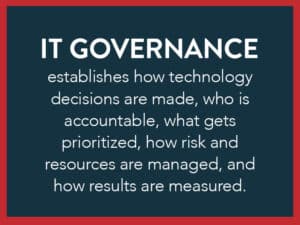
IT governance establishes how technology decisions are made, who is accountable, what gets prioritized, how risk and resources are managed, and how results are measured.
This is much broader and more operationally focused than merely having a business IT strategy.
Strategic IT planning sets out how technology will support your organization’s objectives. Governance provides the structure for making those plans work.
It determines who has authority to make decisions, how competing priorities are assessed, and how you know if technology investments are delivering the expected value.
That makes IT governance an executive responsibility.
Business technology alignment depends on leaders being involved rather than leaving governance solely to the IT department.
Any technology decision can affect your budgets, operations, cybersecurity, compliance, and your ability to grow.
For example, suppose your business plans to acquire another company or open new locations over the next two years. Technology decisions made today need to support that plan.
Your IT governance framework helps leadership assess whether current systems can scale, where you should prioritize investment, what risks you need to address, and who is accountable for getting the business ready.
Effective governance keeps those decisions connected to where your organization is going, rather than allowing technology to develop one immediate requirement at a time.
Why is IT Governance Important for a Growing Business?
Growth increases the number, cost, and business impact of your technology decisions. A structured approach helps you make those decisions with a clear understanding of business priorities, investment requirements, risk, and accountability.
As your organization grows, more people depend on technology. More systems hold critical data. More departments have their own technology requirements.
AI adoption provides a good example.
One department may identify an AI tool that could improve productivity and want to move quickly. Before adoption, you need to understand what data the tool will access (data privacy is a key risk) and whether it meets security and compliance requirements.
You also need to know how it fits with existing systems and whether the expected business value justifies your investment.
The same principle applies to cloud services, hybrid work, cybersecurity, and digital transformation initiatives. Each can support growth, but each introduces decisions about cost, security, infrastructure, people, and long-term technology requirements.
Governance gives you a consistent way to evaluate those competing considerations.
It also creates greater visibility across the organization, helping you identify where technology investment supports your business priorities. Are risks increasing? Will separate decisions pull your organization in different directions?

The Core Components: How to Create an Effective IT Governance Framework
Effective IT governance for mid-market businesses requires an IT governance framework. This brings your business priorities and technology decisions into the same process.
The precise structure will vary between organizations, but you need to address four fundamental areas:
Strategic alignment:
Technology roadmaps, standards, and infrastructure planning should reflect your business goals and give you a clear view of what needs to happen next.
Value and performance:
Technology investments need a defined purpose. IT performance metrics help you assess whether those investments are improving operations, supporting employees, or creating the capacity your business needs to grow.
Resources and oversight:
IT budgeting, vendor management, and technology lifecycle management help you decide where to commit resources and when to maintain, replace, or retire systems.
Risk and resilience:
Cybersecurity oversight, compliance management, and business continuity planning help identify what could disrupt your organization – like poor network and edge security – and establish how you’ll manage those risks.
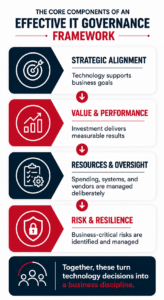
These priorities also appear in established governance frameworks such as ISACA’s COBIT, which connects technology governance with enterprise goals, value, risk, resources, and performance.
You can’t create a technology roadmap, for example, without considering your available resources or the risks associated with aging infrastructure.
Equally, a cybersecurity investment should reflect your organization’s actual risk and business priorities rather than you treating it as an isolated IT purchase.
The framework also needs clear ownership.
Executives need enough visibility to make informed decisions, while your technology leaders need the authority and direction to put those decisions into practice.
Ensure regular reporting to keep both sides connected and provide evidence that technology decisions are producing the intended results.
Common IT Governance Challenges Organizations Face
Weak IT governance often shows up as a series of disconnected challenges across your organization.
A department buys software to solve an immediate need without checking whether an existing system already provides the same capability.
An aging server remains in place because responsibility for replacing it is unclear.
Different teams adopt their own security practices, while leadership has no complete view of the resulting risk.
These decisions can work individually and still create problems collectively.
Over time, shadow IT, overlapping technology investments, inconsistent security policies, and poor vendor oversight make the technology environment harder to manage.
Costs become less predictable. Risk becomes more difficult to assess.
A missing or outdated IT roadmap can leave leaders knowing where the business intends to be in three years without knowing whether current technology can support it. This delays important infrastructure decisions.
The common thread here is limited executive visibility.
Without clear ownership and a consistent decision-making process, you’re left reacting to individual technology problems instead of making informed choices within your IT governance framework.

How Does IT Governance Create Business Value?
IT governance creates business value by helping you
- direct technology investment toward business priorities,
- manage risk, and
- measure whether technology is delivering the expected results.
It provides better information for decisions about where to invest, what to improve, and when spending is unlikely to add sufficient value.
Governance Brings Better Technology Investment Decisions
Good governance gives decision-makers a clearer view of technology spending across the organization. That can expose duplicated applications, underused services, or investments that no longer support current priorities.
A new platform may offer impressive capabilities, but that doesn’t automatically make it valuable to your business. Before approving it, you can consider the expected outcome, total resource commitment, associated risks, and how the investment fits the IT roadmap.
Sometimes the best decision is to invest. Sometimes it is to wait, improve what you already have, or spend the money elsewhere.
IT Governance Improves Operational Performance and Capacity
Technology can become a constraint when business growth outpaces the systems supporting it. Strategic IT planning helps identify those limitations before they begin affecting performance.
For example, an infrastructure upgrade may make more sense six months before a planned expansion than after existing systems begin struggling with increased demand. The value comes from timing the investment around the needs of the business.
The same visibility can help you identify technology that’s creating unnecessary manual work, limiting employee productivity, or making it difficult to scale operations.
A Good IT Governance Framework Reduces the Business Impact of Risk
IT risk management allows you to consider cybersecurity, IT compliance (e.g. for HIPAA), and business continuity alongside operational and financial priorities.
This helps you decide which risks require investment and where existing controls are appropriate.
The goal is informed risk management rather than attempting to eliminate every possible technology risk.
You can prioritize the issues most likely to affect operations, regulatory obligations, customers, or business growth.
Over time, this approach also makes IT spending more predictable.
Planned investment, clearer priorities, and fewer reactive decisions give finance and executive teams a better understanding of what technology will require from your business and what you should expect in return.
How Do You Build an IT Governance Framework That Can Scale?
Build an IT governance framework around clear decision-making authority, business priorities, measurable outcomes, and regular review.
As your organization grows, the framework should provide consistency without making technology decisions unnecessarily slow or complex.
Start with executive ownership. Establish who makes which decisions, when wider leadership needs to be involved, and how technology priorities are assessed against business goals.
Depending on the size and structure of your organization, this may include a formal governance committee or regular strategic technology reviews.
Use an IT roadmap to turn those priorities into planned action. Regular IT assessments can identify changing infrastructure, cybersecurity, compliance, and capacity requirements before they become urgent.
KPIs and reporting then give you visibility into progress, risk, spending, and performance.
Keep reviewing the framework. Why? Business priorities change. Technology changes. New risks emerge. Governance needs to evolve with them if it’s going to continue supporting your growth.
Build a Stronger IT Governance Approach with Katalyst
At Katalyst, we specialize in managed IT consulting. And we believe IT governance best practices should always support where your business is going.
We partner with you to develop an IT governance approach that gives you greater visibility, clearer priorities, and a practical roadmap for future investment.
This may involve assessing your current technology environment, strengthening strategic IT planning, developing a technology roadmap, or establishing better ways to measure performance and manage risk.
The result is a governance framework built around your business goals.
You’ll make technology decisions with greater confidence, plan investment before it becomes urgent, and keep your IT environment aligned with the needs of your growing organization.
IT governance and strategy consulting is part of a sound digital backbone: connecting, protecting, and operating. If you’d like an IT governance approach that can grow with your business, talk to one of our experts today.