Greensboro manufacturers can reduce cybersecurity risks by securing connections between business IT and operational technology (OT), controlling third-party access, and separating critical networks. Regular cybersecurity assessments help identify vulnerabilities before attackers exploit them and threaten production.
Let’s get down to some nitty-gritty first:
Your equipment maintenance contractor has remote access to troubleshoot machinery on your production floor. It’s a routine arrangement that’s worked well for years.
But what if attackers have compromised the contractor’s remote-access account? They could use it to enter your production network, exploit a poorly secured connection to other systems, and deploy ransomware.
Now your production manager is facing a shutdown and your IT team is trying to contain the attack. Worse, nobody knows how far it’s spread.
Could better security around that trusted contractor connection have stopped the attack?
How Can Greensboro Manufacturers Protect Their Networks from Ransomware?
Protecting manufacturing networks from ransomware starts with understanding how your business systems connect to production equipment.
Strong access controls, network segmentation, and continuous security monitoring can limit opportunities for attackers to move between them.
Most manufacturers depend on two types of technology:
- Information technology (IT): Your business systems, including email, accounting, inventory, customer records, and production scheduling.
- Operational technology (OT): The equipment and control systems that monitor or operate your production processes, from automated machinery to industrial sensors.
Your business IT and OT increasingly exchange information. This connectivity helps you manage production efficiently – monitoring performance and making informed decisions.
But it also creates potential pathways for cyberattacks.
Manufacturing cybersecurity therefore needs to account for both environments.
And there’s another complication: some industrial equipment runs on legacy software that can’t easily be updated without disrupting production. This is a common IT governance challenge.
It also means you need to control the boundaries between your systems.
And this is where segmentation comes in.
Why IT and OT Network Segmentation Matters
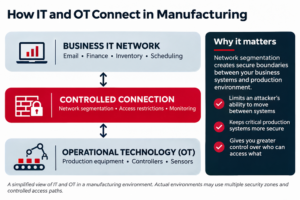
IT and OT network segmentation creates controlled boundaries between your business systems and production environment.
Think of it as installing secure doors between different areas of your facility. Authorized people can pass through, but attackers cannot automatically access everything beyond the door.
Applied to your networks, this means:
- Restricting connections between business IT and production systems to those you genuinely need.
- Controlling and monitoring remote access for equipment suppliers and maintenance contractors.
- Limiting user permissions so employees and outside partners can access only the systems they need.
- Reducing the chance that an attacker who compromises one system can move freely through your network.
Effective IT OT network security requires careful planning. Industrial systems can be sensitive to security changes, so your IT team should coordinate with production managers and qualified OT specialists before making changes that could affect equipment.
How Can Greensboro Manufacturers Prevent Production Downtime?
Greensboro manufacturers can reduce the risk of cyber-related production downtime by protecting critical systems, identifying threats early, and preparing recovery procedures. Even when attackers cannot reach production equipment, disruption to essential business applications can delay manufacturing.
From modern manufacturing to aviation and logistics, Greensboro has a diverse industrial base. But whatever you produce, consider what happens if your machinery is working but your employees cannot access production schedules, inventory records, or shipping instructions.
You may have the equipment, materials, and people ready, yet still struggle to fulfill customer orders.
A practical industrial cybersecurity strategy should address five priorities:
- Know which systems are essential. Identify the business applications, network connections, and operational systems your production teams depend on. Understand what would happen if each became unavailable.
- Strengthen remote access security. Require multifactor authentication (MFA) where supported, restrict contractor access, and promptly remove permissions that are no longer needed.
- Monitor for suspicious activity. Detecting unusual account behavior, unauthorized connections, or potential ransomware activity early gives your team a better chance of containing an attack.
- Protect your backups. Maintain secure, isolated backups of critical business data and configurations. Test restoration procedures so you know what you can recover and how long it might take.
- Plan for operational disruption. Your incident response and disaster recovery plans should identify who makes decisions, how production teams communicate, and when systems can safely return to service.
These measures help protect manufacturing networks from ransomware and improve your ability to recover when something goes wrong.
However, no cybersecurity solution can guarantee uninterrupted production. Your goal is to reduce exposure, limit damage, and restore essential operations safely.
Which Cybersecurity Solutions Do Greensboro Manufacturers Need?
The right cybersecurity solutions for manufacturers in Greensboro, NC depend on your existing systems, production dependencies, and exposure to threats. A structured assessment can reveal weaknesses and help you prioritize improvements without unnecessarily disrupting operations.
Start With a Cybersecurity Risk Assessment
A cybersecurity risk assessment for manufacturing companies should examine more than office computers and email protection.
It should consider how your business network connects to production systems, who has remote access, how you manage user permissions, and whether your recovery arrangements meet operational needs.
Questions worth asking include:
- Do you know every external company with remote access to your systems?
- Are your business IT and OT networks appropriately separated?
- Can you identify unusual activity before it develops into a major incident?
- Have you tested your ability to restore essential business systems?
- Who coordinates the response if a cyberattack threatens production?
You don’t necessarily need to replace equipment or overhaul your network. The first priority is understanding your exposure and deciding which risks need attention.
Katalyst Can Help Your Business Strengthen Its Cybersecurity
We offer a cybersecurity approach from initial risk assessment, through managed security services, to strategic IT guidance.
We pride ourselves on understanding your operations, existing technology, and business priorities before making suggestions – and we’re vendor agostic.
For Greensboro manufacturers, that means considering how cybersecurity decisions affect production continuity, employees, and customer commitments. Where specialist OT expertise is required, security planning should involve the people responsible for your industrial systems.
As cyber threats evolve, your protection needs regular attention. New equipment, software integrations, contractors, and remote connections can change your exposure over time.
As your digital operations partner, Katalyst can help you review changing risks and maintain appropriate protection as your business evolves.
How confident are you that your business IT security is protecting your manufacturing operations?
Schedule a conversation with one of our experts to discuss your cybersecurity risks and the next steps toward a more resilient business.