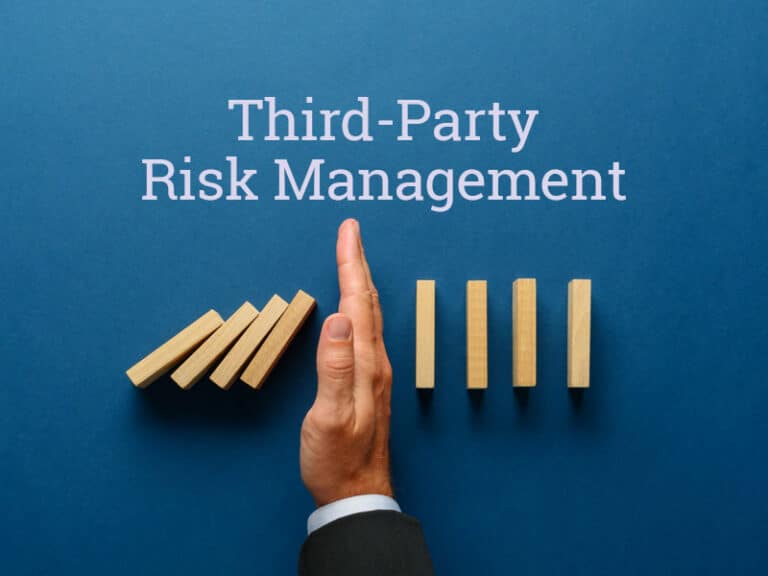
Third-party risk management helps you understand and control the cybersecurity and business risks that enter your organization through vendors, partners, and technology providers.
Table of contents
What Is Third-Party Risk Management?
Why Is Third-Party Cyber Risk Growing?
What Are the Most Common Third-Party Cybersecurity Risks?
How Can Third-Party Risk Affect Your Business?
What Should a Third-Party Risk Assessment Include?
How Do You Build a Third-Party Risk Management Program?
How Does Third-Party Risk Management Support Regulatory Compliance?
How Can Managed Cybersecurity Help Reduce Vendor Risk?
Questions Leaders Should Ask About Third-Party Risk
What Is Third-Party Risk Management?
Third-party risk management is the process of identifying, assessing, and managing the risks created by the outside organizations and technologies your business relies on.
Those third parties can include SaaS and cloud providers, managed service providers, payroll and financial software companies, contractors, consultant, and business partners. Plus the applications and APIs that you now likely connect to your systems. Even your own employees are possibly using shadow IT.
The issue is increasingly important because securing your own network is no longer enough. A vendor may store your data, connect to your infrastructure, or have access to critical systems.
Your vendor risk management strategy needs to account for those connections and the exposure they create.
In practical terms, your cybersecurity posture now depends partly on organizations you do not directly control. This includes AI tools and agents that may have access to your systems or data.
Why Is Third-Party Cyber Risk Growing?
Most organizations rely on more external technology than before. SaaS platforms, cloud services, remote access, APIs, and integrated applications can improve how you operate, but every new connection can also increase third-party security risk.
And growth can add to that exposure. As you introduce new systems, locations, services, and business relationships, you may also increase the number of vendors that can access your data or technology environment.
That makes third-party cyber risk management an ongoing business concern. You need visibility into who has access, what they can reach, and how a security failure elsewhere could affect your organization.
What Are the Most Common Third-Party Cybersecurity Risks?
A third party can create a route into an otherwise well-protected environment. Compromised vendor credentials, weak authentication, excessive access privileges, insecure APIs, unpatched software, and SaaS misconfigurations – all these can increase your exposure.
In addition, visibility creates another challenge. A vendor may use subcontractors, retain access that it no longer needs, or handle your information in ways you may not know about. For example, poor offboarding can leave old accounts, credentials, and integrations active after a relationship ends.
A vendor cybersecurity risk can also originate entirely within the provider’s environment. If that provider suffers a data breach or supply chain attack, your systems, information, or operations may still feel the consequences.
This is why effective third-party cybersecurity requires more than checking a vendor’s security credentials when you first sign a contract.
How Can Third-Party Risk Affect Your Business?
A security problem at a vendor can quickly become your business problem. Particularly when that vendor handles sensitive data or supports a critical operation.
The consequences can include:
- Operational downtime: A cyberattack or outage at a critical provider can interrupt the systems and services your employees or customers rely on.
- Data loss or exposure: Vendors that store or process sensitive information can put customer, employee, financial, or healthcare data at risk.
- Regulatory and compliance issues: A third-party breach may leave your organization facing questions about vendor due diligence, security controls, and regulatory compliance.
- Financial losses: Business interruption, recovery costs, lost productivity, and potential liability can increase the financial impact of an incident.
- Supply chain disruption: In manufacturing and other interconnected industries, an incident affecting a key supplier or technology provider can interfere with production and delivery.
- Reputational damage: Customers and other stakeholders may hold your organization responsible for protecting their information. Even when a third party caused the breach.
Third-party risk can also affect cyber insurance requirements and claims.
For leadership teams, the important point is that vendor cybersecurity risk is business risk. Understanding which providers could materially disrupt your organization helps you make decisions. These include closer assessment, stronger controls, and ongoing oversight.

What Should a Third-Party Risk Assessment Include?
How should you assess vendor cybersecurity risk? Start by recognizing that not every vendor creates the same level of risk.
A company delivering office supplies doesn’t require the same scrutiny as a cloud provider storing customer data or a contractor with privileged access to your network.
A third-party risk assessment should establish what a vendor can access. Also what information it handles, how critical its services are to your operations, and what would happen to your business if its security failed.
How Do You Assess Vendor Cybersecurity Risk?
Start with the relationship between the vendor and your organization. What systems, applications, and infrastructure can it access? What data does it store, process, or transmit on your behalf? Does it need remote access to your environment?
The answers help determine the depth of the vendor security assessment you need. A healthcare organization, for example, should apply greater scrutiny to a provider handling protected health information. And perhaps less to one with no access to patient data or critical systems.
Which Vendor Security Controls Should You Assess?
For higher-risk vendors, look beyond a standard security questionnaire. Your assessment may need to examine authentication and MFA, encryption, security policies, incident response procedures, backup and recovery, security certifications, data retention, and cyber insurance.
You should also understand whether your vendor (Tier 2) uses subcontractors (Tier 3) to provide its service. Your direct provider may have strong controls while depending on another organization that also handles your data or supports a critical part of its operation.
How Do Compliance and Contracts Affect Vendor Risk?
Your vendor due diligence should account for the regulatory requirements that apply to your organization and the information the vendor handles. It should also establish contractual security obligations, including responsibilities for protecting data and responding to an incident.
The level of scrutiny should follow the level of risk.
A credit union relying on a provider that processes sensitive financial information, for example, needs greater assurance than it does from a vendor with no access to member data.
A useful third-party risk assessment therefore does more than ask whether a vendor has appropriate security controls. It helps you understand how much that vendor matters to your business and what level of oversight the relationship requires.
How Do You Build a Third-Party Risk Management Program?
A strong third-party risk management program follows the vendor relationship from the first evaluation through to the day that relationship ends. The practical starting point is knowing which third parties matter most and applying your resources accordingly.
Identify, Assess, and Prioritize Your Vendors
Start by identifying the vendors, applications, partners, and other third parties with access to your systems, infrastructure, or data.
Then assess the risk each relationship creates based on factors such as the sensitivity of the information involved, the level of access granted, and how critical that provider is to your operations.
Prioritization matters because you cannot treat every vendor as equally risky.
A manufacturer that depends on an external provider to keep a production system running has a different exposure from one using a low-impact SaaS application with no access to sensitive data.
Your priorities should also reflect your organization’s risk appetite – the level of risk leadership is prepared to accept in pursuit of business objectives. Higher-risk relationships may require stronger controls, more frequent reviews, or changes to the way you work with that provider.
Control and Monitor Third-Party Risk
Once you understand the risk, establish appropriate security requirements.
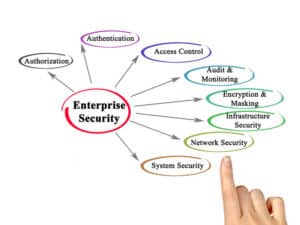
These may include limiting access and permissions, requiring stronger authentication, setting contractual security standards, and defining who within your organization owns the vendor relationship.
Monitoring should continue throughout that relationship. Vendor systems, services, personnel, and security practices can change, and so can your own dependence on them. Regular review helps you identify new vendor security risks, excessive permissions, or changes that could affect your compliance or business continuity.
This ongoing oversight is a central part of cybersecurity vendor risk management. A security questionnaire completed during procurement tells you about a vendor at one point in time. It does not tell you what the risk looks like a year later.
Offboard Vendors Securely
Vendor lifecycle management means third-party access should end when the business relationship does.
Remove user accounts, credentials, permissions, remote access, and system integrations that the vendor no longer needs.
You should also establish what happens to company or customer data the provider retains and confirm that contractual data-retention and deletion requirements have been met.
Secure offboarding closes a gap that can otherwise remain unnoticed long after a vendor has stopped providing its service.
How Does Third-Party Risk Management Support Regulatory Compliance?
When you give a third party access to regulated or sensitive information, its security practices can become relevant to your own compliance responsibilities.
The exact requirements depend on your industry and the relationship.
A healthcare organization, for example, needs to understand which vendors qualify as Business Associates when they handle protected health information. A financial institution or credit union needs appropriate oversight of service providers that access sensitive financial or member information.
NIST frameworks and guidance can also help organizations build third-party and supply chain risk into their wider cybersecurity governance.
Cyber insurers may ask similar questions about vendor access, security controls, and how you manage critical providers.
The practical lesson is simple: Know which compliance obligations follow your data and systems when a third party becomes involved. Your vendor due diligence, contracts, access controls, and ongoing monitoring should reflect those obligations.
How Can Managed Cybersecurity Help Reduce Vendor Risk?
Managing third-party risk in a complex mid-market organization requires visibility across your technology environment and the relationships connected to it. A strategic cybersecurity partner can help you build that view and maintain it as vendors, systems, and business needs change.
That can include identifying third-party connections and assessing higher-risk vendors. It may involve reviewing access and permissions, strengthening identity controls, and monitoring suspicious activity. Vendor oversight can then become part of your wider cybersecurity governance and incident response planning.
For Katalyst, this forms part of managing the digital backbone that supports your organization. The aim is to give your leadership team a clearer view of where third-party risk exists, who owns it, and where action is needed.
That ongoing partnership is important because vendor risk does not stand still. Neither should your understanding of it.
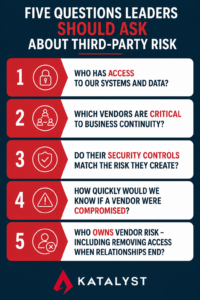
Questions Leaders Should Ask About Third-Party Risk
Strengthen Your Third-Party Risk Management with Katalyst
Your cybersecurity extends beyond the systems you control directly, so greater visibility and accountability across third-party relationships can strengthen security, compliance, and operational resilience.
If you need a clearer picture of the risks your vendors and technology partners introduce, Katalyst can help you assess those relationships and identify where stronger controls or oversight may be needed.
Schedule a call with one of our experts to discuss third-party risk across your technology environment.