If your business has grown quickly over the last few years, your technology environment has probably become more complex than you originally planned for. This is why, increasingly, growing businesses are turning to managed IT services.
Cloud platforms, hybrid work, AI tools, remote access, compliance pressures, and rising cyber threats have changed what you now need from your IT infrastructure.
At the same time, downtime has become far more expensive. A single outage can disrupt operations, delay communication, affect customer service, and expose gaps in your cybersecurity strategy.
That’s why managed IT services now play a much larger role than traditional outsourced IT support.
Instead of waiting for problems to appear, you get proactive IT support, stronger cybersecurity, infrastructure oversight, and long-term IT consulting that supports your growth and operational stability.
Your technology systems now influence your productivity, security, scalability, and day-to-day business performance. So, as a growing company, your IT environment needs to become an effective digital backbone.
Table of contents
Why Are Businesses Investing More in Managed IT Services?
What Should Managed IT Services Include?
How Stronger Cybersecurity Helps Protect Compliance, and Reduce Risk
How Managed IT Services Help You Scale More Efficiently
The Future of IT Operations and Cybersecurity For Mid-Market Businesses
Why Businesses Choose Katalyst for Managed IT Services
 Why Are Businesses Investing More in Managed IT Services?
 Why Are Businesses Investing More in Managed IT Services?
Businesses are investing more in managed IT services because reactive IT support can no longer keep pace with cybersecurity risks, operational demands, and business growth.
For example, if your current IT model only responds when something breaks, productivity has already been affected. Your employees depend on connected platforms throughout the day. Downtime, failed updates, security gaps, and unreliable systems can quickly disrupt operations.
You may also be managing far more technology than you were a few years ago.
Cloud applications, remote devices, third-party vendors, communication platforms, and the latest AI agents and tools all increase operational complexity and expand your potential attack surface.
Cybersecurity threats are also evolving at the same pace. Phishing attacks, ransomware, credential theft, and AI-assisted scams are now targeting businesses of every size.
And your employees are likely using unmanaged AI tools and cloud platforms without clear governance. This creates additional security and compliance risks.
When your internal team spends most of their time reacting to “digital noise,” long-term planning often gets pushed aside.
This makes it harder to improve infrastructure, standardize systems, strengthen network security services, or prepare for future growth.
On the other hand, managed service providers help you move away from that cycle through:
- proactive monitoring
- business cybersecurity solutions
- ongoing IT support
- strategic IT planning that supports growth
Instead of waiting for failures, you gain greater visibility into risk, system performance, and operational stability before disruptions escalate.

What Should Managed IT Services Include?
Modern managed IT services should include proactive support, cybersecurity protection, infrastructure oversight, cloud management, and long-term IT planning.
Modern mid-market businesses need technology environments that are monitored, maintained, secured, and reviewed continuously.
Proactive monitoring is crucial.
Your systems, devices, servers, and network infrastructure need ongoing oversight to identify performance issues, vulnerabilities, failed updates, and unusual activity before they affect operations.
At the same time, your employees still need responsive day-to-day IT support.
Delayed ticket responses, recurring technical problems, and inconsistent systems quickly reduce productivity and frustrate your staff. Strong managed IT support should help your team work efficiently – whether employees are in the office, remote, or moving between locations.
Cloud services also play a much larger role than they did a few years ago.
Many businesses now rely on cloud platforms for communication, collaboration, storage, cybersecurity, backups, and remote access.
Cloud environments can become fragmented, expensive, and difficult to secure if they’re not managed effectively.
Managed IT services should also include network security services, infrastructure oversight, and long-term IT consulting.
As your business grows, your technology environment needs to scale with it. That includes planning for hardware lifecycles, vendor management, cybersecurity improvements, compliance requirements, and future operational demands.
The goal is not simply to keep systems running. You need to build a stable, secure, and scalable IT environment that supports your business as it grows.

How Stronger Cybersecurity Helps Protect Compliance, and Reduce Risk
Cybersecurity now sits at the center of IT operations because cyber threats increasingly target your employees, cloud platforms, devices, vendors, and business data simultaneously.
A few years ago, cybersecurity was often treated as a separate technical concern. Today, it directly affects your operational stability, customer trust, compliance readiness, and ability to scale safely.
The threat landscape has changed rapidly.
Phishing emails are becoming more convincing through AI-generated content. Ransomware groups are targeting mid-market businesses because they often have fewer internal security resources than large enterprises.
At the same time, employees regularly use cloud tools and AI platforms without formal governance. This increases your risk of data exposure and credential compromise.
Hybrid work has added another layer of complexity. Your employees may now access systems from multiple locations, personal devices, public networks, and cloud applications throughout the day.
Every additional access point creates another potential vulnerability if security policies and monitoring are inconsistent.
That’s why modern business cybersecurity solutions need to go far beyond antivirus software or occasional password changes. Managed IT services are often the best solution.
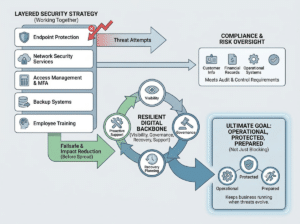
Layered Cybersecurity for Stronger Protection
Endpoint protection, network security services, access management, multi-factor authentication, backup systems, and employee cybersecurity training now work together as part of a layered security strategy.
If one area fails, another layer helps reduce the impact on your business before the issue spreads across your environment.
Cybersecurity also affects compliance and risk management. Depending on your industry, you may need stronger controls around customer information, financial records, operational systems, or employee data.
Without clear oversight, your business can struggle to meet compliance and audit requirements or recover quickly after a security incident.
A resilient digital backbone depends on visibility, governance, recovery planning, and proactive cybersecurity support working together in a layered approach.
The goal is not simply to block attacks. It’s to keep your business operational, protected, and prepared when threats evolve.

How Managed IT Services Help You Scale More Efficiently
Managed IT services help you scale more efficiently without expanding internal teams – by improving operational stability, reducing technical friction, and supporting long-term business growth.
As your business grows, your technology environment becomes more difficult to manage consistently.
That’s because everything scales with you: new employees, additional locations, cloud platforms, remote access requirements, vendors, and compliance demands.
Unfortunately, operational complexity can take your focus away from your main business of growing – and without a clear IT strategy, you can often end up with:
- fragmented systems
- inconsistent security policies
- aging hardware
- disconnected platforms
These slow your productivity instead of supporting your growth.
Scaling also places more pressure on internal IT teams, leaving little capacity for infrastructure planning or long-term improvement projects to support your new growth.
Managed IT Services Help Reduce This Operational Strain
With proactive support and ongoing infrastructure oversight from a managed service provider acting as a long-term technology partner, you can standardize your systems.
This improves visibility across your environment and reduces the disruptions that often appear during periods of growth.
Your employees spend less time dealing with technical issues – while leadership gains more predictable technology performance and support costs.
Strong IT consulting also helps you make better long-term decisions around cybersecurity, cloud services, hardware lifecycles, software platforms, and vendor relationships.
And instead of adding technology reactively, managed IT services help you align your IT environment with your operational goals and future business plans.
That becomes increasingly important as you adopt more cloud infrastructure, automation tools, AI platforms, and hybrid work models.
Why? Because growth depends on your systems remaining secure, scalable, and manageable as operational demands on them increase.
A strong digital backbone supports your growth by helping your business stay connected, productive, and resilient.

The Future of IT Operations and Cybersecurity For Mid-Market Businesses
Mid-market businesses are moving toward long-term IT partnerships that combine cybersecurity, cloud infrastructure, operational planning, and continuous support.
Complexity for growing businesses is increasing. And cyber threats are becoming faster, more automated, and harder to detect.
For example, AI tools are exploiting vulnerabilities and carrying out sophisticated phishing campaigns almost faster than human-led and AI-assisted security defenses can respond.
And “shadow IT” now includes the use of unauthorized AI agents – creating governance blind spots.
That means you need proactive cybersecurity strategies, stronger governance around technology usage, and better visibility across your systems and infrastructure.
Scaling successfully over the next few years will mean having secure, stable, well-managed environments that support operational resilience.
Managed IT services support this. Short-term fixing doesn’t.
Why Businesses Choose Katalyst for Managed IT Services
Your business needs more than a vendor that fixes isolated technical problems. You need a technology partner that understands how cybersecurity, infrastructure, operational stability, and long-term growth connect across your business.
Katalyst provides managed IT services, cybersecurity services and solutions, cloud services, and modern network infrastructure support that’s designed around operational performance, resilience, and scalability.
Instead of pushing one-size-fits-all solutions, we take a vendor-neutral approach to IT consulting.
That allows you to build technology environments based on your operational goals, security requirements, workforce needs, and growth plans.
We understand the operational pressures facing businesses, including hybrid work, compliance demands, cybersecurity risk, infrastructure complexity, and scaling challenges.
We help you strengthen the IT services that support your day-to-day operations.
And we stay with you and take responsibility for what we do. That includes proactive support, stronger cybersecurity, infrastructure visibility, and long-term strategic planning designed to reduce risk and support sustainable growth.
Partner With Katalyst For Managed IT Services
Katalyst will help you design, protect, and continuously improve a customized digital backbone that supports your business operations.
As a Digital Operations Partner in Charlotte, Spartanburg and the surrounding towns, we work alongside you to reduce operational risk, strengthen your cybersecurity, and build and maintain a technology environment designed to scale with your business.
If having a managed service provider sounds like your next step, schedule a consultation today and talk to a Katalyst expert.
Image attribution © Katalystng.com prompted via ChatGPT