Your business depends on technology every day. But do you know which cybersecurity weaknesses could cause the greatest disruption?
As your business grows, so does its exposure to cyber threats.
A cybersecurity risk assessment helps you identify where you’re vulnerable, understand the potential consequences, and decide where to invest in protection.
Table of contents
What Is a Cybersecurity Risk Assessment?
Why Do Cybersecurity Risk Assessments Matter for Mid-Market Businesses?
What Is Included in a Cybersecurity Risk Assessment?
How Do You Conduct a Cybersecurity Risk Assessment?
What Is the Difference Between a Cybersecurity Risk Assessment and a Vulnerability Assessment?
What Should You Expect From a Cybersecurity Risk Assessment?
How Often Should Your Business Conduct a Cybersecurity Risk Assessment?
How Do Managed Cybersecurity Services Support Ongoing Risk Management?

What Is a Cybersecurity Risk Assessment?
A cybersecurity risk assessment is a structured process that identifies potential threats to your business, evaluates your existing security measures, and prioritizes the risks you face. It helps you understand the likelihood and potential impact of a cyber incident so you can make informed decisions about protecting your organization.
Unlike a purely technical review, a cyber risk assessment considers how security weaknesses could affect your operations.
It connects your IT security risk assessment findings to the business outcomes your leadership team needs to protect.
For mid-sized businesses, this is particularly valuable. You may have complex technology requirements without the dedicated security resources of a large enterprise.
Why Do Cybersecurity Risk Assessments Matter for Mid-Market Businesses?
Risk assessments help you focus your security investment where it can make the greatest difference. They:
- reveal potential threats to business continuity
- highlight gaps in existing defenses, and
- provide evidence for decisions about managing cyber risk.
Ransomware, compromised credentials, unpatched systems, and third-party vulnerabilities are familiar threats.
But a common threat isn’t necessarily your company’s highest-priority risk.
For example, a vulnerability affecting a rarely used internal application may pose less immediate danger than inadequate access controls protecting your customer database.
The risk assessment establishes which weaknesses could cause the most serious damage to your business. That might mean operational downtime, financial loss, regulatory consequences, or disruption to customers.
It also helps you avoid spending money on security solutions that don’t address your greatest exposure.
For CFOs and other executives responsible for budgets, this provides a clearer basis for evaluating cybersecurity investment. For IT leaders, it helps justify the resources needed to reduce risk.
What Is Included in a Cybersecurity Risk Assessment?
A comprehensive cybersecurity risk assessment examines the systems and information your business depends on, the threats they face – and the effectiveness of your existing safeguards.
The scope will vary according to your business, but typically includes:
- Critical assets: Business applications, infrastructure, sensitive information, and systems essential to daily operations.
- Threats and vulnerabilities: Potential attack methods, security weaknesses, and opportunities for unauthorized access.
- Existing security controls: How effectively your current technology, policies, and procedures reduce exposure.
- Third-party dependencies: Risks introduced by vendors, service providers, and external systems connected to your business.
- Business impact: The operational and financial consequences if an identified risk becomes a reality.
A cybersecurity risk assessment checklist for businesses can help establish the scope, but it shouldn’t dictate your priorities.
The assessment must reflect how your organization actually operates, including the systems you cannot afford to lose.
How Do You Conduct a Cybersecurity Risk Assessment?
Conducting a cybersecurity risk assessment involves identifying what needs protection, evaluating potential threats, and deciding how to address the risks. A consistent security risk assessment framework makes the process more reliable and helps you measure progress over time.
The NIST Cybersecurity Framework (CSF) 2.0 provides a recognized approach to managing cybersecurity risk. Its six functions – Govern, Identify, Protect, Detect, Respond, and Recover – help organizations establish security priorities and improve their resilience.
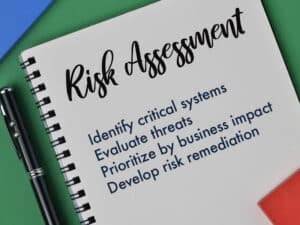
The following four stages provide a practical approach.
1 Identify Critical Systems and Business Assets
Start by identifying the technology and information your business needs to function.
Involve the people responsible for critical business operations, as they may recognize dependencies and potential disruptions that aren’t obvious to your IT team.
Which systems support your essential operations? Where do you store sensitive information? What would happen if employees suddenly lost access to a critical application?
Consider dependencies between systems, too. For example, a Greensboro manufacturer might find their production system remains operational while a failure elsewhere prevents employees from accessing schedules or processing orders.
This stage establishes what you need to protect and why.
2 Evaluate Threats, Vulnerabilities, and Existing Controls
Next, examine how those assets could be compromised and whether your existing safeguards provide adequate protection.
This may involve reviewing access permissions, software vulnerabilities, network configurations, backup arrangements, and security monitoring.
Your assessment should also consider human factors. Employees may inadvertently expose sensitive information by responding to phishing messages or mishandling access credentials.
Existing controls make a difference. A potential threat that you already manage effectively may require less immediate attention than an unprotected weakness elsewhere.
3 Prioritize Cybersecurity Risks by Business Impact
How do you prioritize cybersecurity risks when your assessment identifies multiple weaknesses? This is a key consideration.
Evaluate the likelihood of each risk and the consequences if it occurs. Consider the effectiveness of existing controls and how exposed the affected systems are.
A vulnerability that could interrupt your primary revenue-generating operation may deserve urgent attention. Another weakness might be less critical because its potential impact is limited.
Assigning risk ratings helps you compare findings and determine where action is most urgent.
This is where cybersecurity risk management becomes a business decision.
Leadership must determine which risks require immediate investment, which can be reduced over time, and which your organization is prepared to accept.
4 Develop a Risk Remediation Roadmap
Your findings need to translate into practical action.
A remediation roadmap should identify the improvements required, assign responsibility, and establish realistic deadlines.
Some actions may be relatively straightforward, such as correcting access permissions or updating vulnerable software. Others may require substantial investment or changes to your infrastructure.
Prioritize the work according to business impact rather than attempting to address every finding simultaneously.
Your roadmap should also establish how you will verify improvements and measure progress against your cybersecurity goals.

What Is the Difference Between a Cybersecurity Risk Assessment and a Vulnerability Assessment?
A vulnerability assessment identifies technical weaknesses that attackers might exploit.
A cybersecurity risk assessment considers those weaknesses alongside other threats and evaluates their potential consequences for your business.
Both support better cybersecurity decisions, but they answer different questions.
Vulnerability Assessment
Where are our technical weaknesses?
Examines systems, networks, and applications
Identifies and prioritizes vulnerabilities
Guides technical remediation
Cybersecurity Risk Assessment
Which threats pose the greatest business risk?
Considers technology, people, processes, and business dependencies
Evaluates likelihood, impact, and existing controls
Informs broader risk management and investment decisions
Katalyst’s vulnerability assessment services include comprehensive scanning, risk scoring based on exposure and business impact, and practical remediation guidance.
These findings can contribute valuable evidence to a broader cybersecurity risk assessment.

What Should You Expect From a Cybersecurity Risk Assessment?
An effective assessment should give your leadership team a clear understanding of your organization’s cybersecurity exposure and a practical plan for reducing it.
You should expect more than a lengthy report of technical findings.
The most useful deliverables include a prioritized risk register, an explanation of potential business consequences, and a remediation roadmap that identifies recommended actions.
Your IT leadership should be able to explain to you which risks require urgent attention and which improvements will provide the greatest benefit.
You also need enough information to evaluate costs, approve investments, and establish accountability.
A good assessment also creates a baseline against which you can measure future progress.
Without that baseline, it’s difficult to know whether your cybersecurity spending is actually reducing risk.
When Katalyst worked with a North Carolina food manufacturer, the IT Director immediately recognized in our Security Consulting Engineer the expertise he had been looking for: a comprehensive list, well presented, with someone who could not just produce results but interpret, prioritize, and build a roadmap.

How Often Should Your Business Conduct a Cybersecurity Risk Assessment?
Most mid-market businesses should consider a comprehensive cybersecurity risk assessment at least annually – with additional reviews when significant changes affect their risk exposure.
An annual assessment provides a useful starting point, but your risk profile doesn’t remain unchanged between reviews.
You may need to reassess following a major technology implementation, business acquisition, security incident, or substantial change in your operations.
New regulatory obligations or changes in your third-party relationships may also justify an additional review.
Meanwhile, vulnerability scanning and other security monitoring activities should continue more frequently.
The aim is to maintain an accurate understanding of your exposure rather than relying on findings that may no longer reflect your business.

How Do Managed Cybersecurity Services Support Ongoing Risk Management?
Managed cybersecurity services help businesses maintain visibility into changing threats and act on assessment findings over time.
A cybersecurity risk assessment identifies where you stand. Ongoing cybersecurity risk management helps ensure that weaknesses don’t remain unresolved and new threats receive appropriate attention.
For mid-market organizations with limited internal security resources, cybersecurity risk assessment services can provide specialist expertise without requiring a large in-house cybersecurity team.
Katalyst’s Security Analysis & Roadmap approach connects assessment findings with practical improvements. Its broader managed cybersecurity services can then support ongoing monitoring and security management.
This reflects Katalyst’s Assess–Transform–Manage approach: Understand your current position, implement necessary improvements, and maintain protection as your business evolves.
Ultimately, the value of a cybersecurity risk assessment depends on what you do with the findings.
Knowing your risks is the starting point. Reducing them is the objective.
Katalyst Can Help You Identify, Prioritize, and Manage Cybersecurity Risks
When we work with you as a digital operations partner, we pride ourselves on being accountable for what keeps your organization running – it’s what gets us out of bed in the morning.
If you’d like to discuss a cybersecurity risk assessment for your business – or explore how Katalyst can help you manage cyber risk – call us and let’s talk.