Disruptions, Patching, Shielding, And Modernization
Last week, Palo Alto Networks (PANW) CEO Nikesh Arora shared his thoughts on the major provider disruptions witnessed the past few weeks. He called out a few specific items. Abridged version below:
“First, the significant volume of patches will continue to be required for at least the next 18 months, carrying ongoing risks of collateral damage.”
“Second, the need for virtual patching will grow across all industries and software categories, allowing organizations to securely and comfortably shield their infrastructure in line before applying their patch.”
“Third, the reality for every enterprise is that there is no silver bullet for preventing an attack, and organizations can no longer assume it won’t happen to them. When an attack hits, because it will, defenders have to be ready to detect and remediate in record time rather than relying on reactive BAND-AIDs. Therefore, we believe the third part of the antidote is most important, which is modernizing the north of $1 trillion of legacy security and IT infrastructure onto real-time platforms.”
Level Setting & Simplifying the message
At a basic level, a vulnerability is a flaw in a system. An exploit is the way that flaw gets abused.
We’ll use the analogy of a house. The vulnerability is a broken second story window. The exploit would be an attacker with a ladder against the house, climbing through the broken window.
Until recent times, vulnerabilities would be discovered in software or a system by human auditing and tooling. The vulnerability would be shared with the vendor of the system so they could create an update (a software patch) to install to resolve it. The patch would close the gap.
Attackers race to find ways to exploit the vulnerability, and once they had a working exploit, they seek out and target vulnerable systems where a patch had not yet been deployed.
This is an age-old battle.
Patch installs have been standard operating procedure. In the Microsoft world, “Patch Tuesday” became an unofficial time for patching, as Microsoft rolls out a set of updates and patches on the second Tuesday of the month.
Patches are usually applied in a maintenance window as systems may be offline while being updated. Each patch also introduces a risk that a system does not come online as expected, prolonging the outage.
Now with that understanding, imagine the volume of patches has doubled. Or tripled. Or quadrupled. Has your IT team? Is 2-4x more planned downtime okay? How about unplanned?
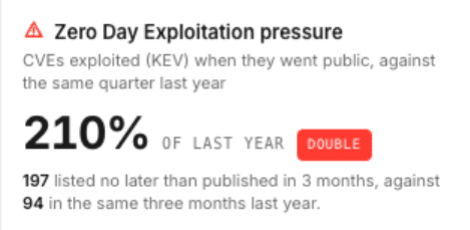
This year, with the advances of AI, the discovery of these vulnerabilities has been supercharged. The expectation is that the next 12-18 months will continue this trend.
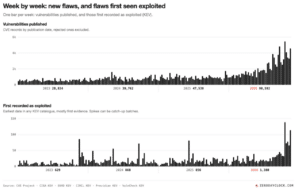
And this is his first point.
The need for patching is greater than it has ever been, and that introduces operational chaos and unanticipated downtime (the ‘collateral damage’ he is referring to).
But not patching leaves you exposed to cyber risk, especially if the systems where the vulnerabilities exist are directly connected and accessible over the internet (like firewalls and web servers).
His second point introduces one of the alternatives to non-stop patching available today, often called virtual patching or predictive shielding.
Instead of installing the patch on a system, or in the case of a zero-day vulnerability (more on that in a moment) where no patch is even available, you can use other means to protect the vulnerable system.
Going back to our house analogy, the vulnerability discovered at your house is the second-story window is broken. An attacker created an exploit where they brought a ladder to the side of your house to climb up and enter through the window.
Virtual patching or predictive shielding would be you boarding up the window until you could have the glass replaced.
It mitigates the vulnerability, buying you time to get the real fix in place, and can be done ‘live’, without the collateral damage.
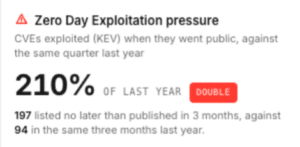
This is extra valuable in situations where a zero-day vulnerability has been published. These are vulnerabilities the vendor or defender aren’t aware of and/or where there is no available fix. In other words, no patch is available to apply.
The use of advanced AI models has made public zero-day vulnerabilities more common and their exploitation faster than ever before.
Back to the house analogy, you can think of a zero-day vulnerability as having a defective lock that you don’t know or realize is broken. An attacker with the right exploit (knowing how to abuse the defective lock) could unlock the door and get in.
When you don’t have a patch to apply but know what an attacker would/could do to exploit the system, shielding can help (if the attacker needs to get to the door lock, you can put up a fence to keep them away).
Technologies for shielding and virtual patching are available from providers like Palo Alto Networks, Cisco, Fortinet, Microsoft, and many others.
His final point is that in the AI era, all businesses are a target for cyber criminals. Threat actors are leveraging agentic frameworks and open-source language models that increase the speed and complexity of attacks while minimizing the effort needed to accomplish them.
In other words, it’s easier than ever for the bad guys to attack your business and if you’re running a cybersecurity program that relies on
- Old, legacy technologies
- A belief that “we’re too small”
- ‘We’re fine, we have MFA’
You are at risk and should prioritize action immediately.
How Katalyst Can Help
If you don’t want to deal with the operational burden and the complexity required to maintain, patch, and protect your systems 24 hours a day, our Managed Services can take that off your plate.
If you’re a heavy Microsoft customer looking to extend your patching and vulnerability management efforts to include things like shielding, Microsoft Defender for Endpoint provides Automatic Attack Disruption and Predictive Shielding, and we can help you get it properly licensed and configured.
If you’re looking to refresh hardware or are already running modern Cisco devices, Cisco Hypershield and Cisco Live Protect are powerful, eBPF-based technologies that provide shielding across workloads and, notably, across the network fabric. We’re happy to help you validate your platform readiness as these technologies continue to roll out the rest of 2026.
If you’re actively using Fortinet technologies or the Fortinet platform for your cyber efforts, you may have FortiGuard Virtual Patching Service available. Similarly, we can help you verify and incorporate into your operations.
And if you have some legacy systems and can’t really be certain that you don’t have key systems that are out of support or marked as end of life, we can help inventory and assess your digital backbone to build a roadmap and game plan to keep you protected.
We realize that this era of technology can be intimidating, confusing, and sometimes downright scary. As a digital operations partner for businesses like yours, we’re always available to chat and address the questions or concerns you have.