Managed IT services have become a strategic imperative. Gone are the times when IT could sit quietly in the background. If systems were up and your helpdesk responded quickly, you could feel reasonably confident.
That model no longer holds. You have to be accountable for your IT environment at all times.
Why?
Because, as a modern mid-market organization, your growth trajectory, your cybersecurity exposure, and your operational resilience are directly tied to how well you manage your technology environment.
You can’t afford to risk your reputation with security breaches or non-compliance. You can’t afford system downtime or staff burnout through firefighting. The impact is no longer merely technical.
So, your strategy has to move to partnering with ongoing managed IT services.
In this article, we’ll look in detail at the crucial topic of managed IT services and their relationship to your stability, security, and growth.
If you’ve been reconsidering your IT strategy in terms of ongoing proactive management and optimization for security and growth, read on.
Table of contents
What Are Managed IT Services in the Modern Mid-Market Context?
What Managed IT Services Actually Include in a Mid-Market Environment
Why Mid-Market Businesses Outgrow Traditional IT Models
Managed IT Services and Cybersecurity – Why Security Must Be Embedded
The Strategic Role of a Managed IT Services Provider
Managed IT Services vs. IT Outsourcing – Understanding the Difference
Service Level Agreements and Performance Standards That Actually Matter
How Managed IT Services Reduce Risk and Enable Sustainable Growth
Choosing the Right Managed IT Services Company for Your Organization
What Success Looks Like With the Right Managed IT Services Partner

What Are Managed IT Services in the Modern Mid-Market Context?
Reactive IT models struggle in the complex environment you find yourself in as a mid-market business.
They address issues after disruption occurs. They patch vulnerabilities after exposure. And they expand infrastructure only after performance degrades.
For organizations operating across multiple locations, cloud platforms, compliance frameworks, and vendor ecosystems, that approach creates friction at precisely the moment you’re trying to scale. It’s frustrating – and time-consuming. And time is a business issue. Always.
Modern IT managed services, on the other hand, are built around proactive oversight, structured governance, and risk mitigation. They align technology performance with your business priorities – whether that means supporting acquisitions, enabling remote work securely, or preparing for audit scrutiny.
In this environment, partnering with managed IT services protects what you’ve built and makes possible what you plan to build next. Break-fix services from a fully outsourced team are unacceptable.
And co-managed IT can be effective – but it requires clearly defined accountability. Without that structure, risk gaps and ownership confusion emerge quickly. We’ll discuss this difference in more detail further down.
But it’s clear that stable IT performance is now inextricably linked to business growth. Which brings us to what you should expect from a managed IT service provider.

What Managed IT Services Actually Include in a Mid-Market Environment
When you’re evaluating a possible partnership with managed IT services as a strategy, the scope should reflect the operational complexity of your organization. Don’t settle for a small-business template.
Here are the services you should consider including in any agreement.
Infrastructure and IT Infrastructure Management
Mid-market environments rarely operate on a single platform. You may be balancing on-premise infrastructure, hybrid cloud deployments, SaaS applications, and third-party integrations.
Effective IT infrastructure management ensures those systems are monitored, maintained, and optimized continuously. This includes network stability, server performance, endpoint management, and cloud managed services oversight.
Although uptime is important, the real goal is performance stability that allows your teams to operate without friction and your leadership team to plan without uncertainty.
24/7 Monitoring and Proactive Managed IT Support
True managed IT support involves continuous monitoring. Issues are identified and resolved before they disrupt your operations.
Proactive IT support shifts your business posture from response to prevention. Instead of waiting for a failure to escalate into downtime, your managed services provider monitors system health, application behavior, and network performance in real time.
For your executive team, this translates into fewer operational surprises and more predictable performance. You can make business forecasts more confidently.
Embedded Cybersecurity and Managed IT Security Services
Cybersecurity must not be a separate initiative. It must be embedded within your managed IT services model.
Managed IT security services integrate vulnerability management, endpoint protection, managed detection and response, and access control governance into daily operations.
In other words, cybersecurity managed services operate alongside infrastructure management, not parallel to it.
This integration strengthens your IT risk management posture and reduces the likelihood that overlooked vulnerabilities will disrupt your operations.
Strategic Roadmap Planning and IT Operations Management
A mature managed services provider doesn’t stop at technical oversight.
IT operations management should include structured planning aligned to your business objectives. Whether you are expanding geographically, modernizing applications, or preparing for regulatory audits, your technology roadmap must reflect those priorities.
Mid-market IT solutions must account for scale, compliance exposure, and growth velocity.
Without that forward planning, technology becomes reactive again – and reactive environments slow your growth.
For that reason, it’s worth reviewing why you’ve outgrown those older ways of working…
 Why Mid-Market Businesses Outgrow Traditional IT Models
 Why Mid-Market Businesses Outgrow Traditional IT Models
As organizations scale, internal IT teams often face structural limits.
You may have capable engineers. You may even have a strong IT director. But staffing ceilings, specialized skill gaps, and increasingly complex security create pressure that’s difficult to absorb internally.
Tool sprawl becomes common. Multiple vendors manage different segments of your environment. Security platforms multiply. Legacy apps spring up ad hoc. Reporting fragments. Costs fluctuate unreliably.
At this stage, senior leaders often realize that the internal model is absorbing operational strain, increasing downtime, and detracting from strategic focus.
A mature MSP for mid-market organizations brings depth across infrastructure, security, compliance, and vendor management under a unified governance structure.
Instead of adding headcount reactively to firefight, you transition toward predictable service models with IT managed services that stabilize cost and expand capability.
Managed IT Services and Cybersecurity – Why Security Must Be Embedded
 Managed IT Services and Cybersecurity – Why Security Must Be Embedded
You cannot bolt security onto infrastructure as an afterthought. It has to integrate into the core of your managed IT services model. Otherwise crucial aspects slip through the cracks.
At the very least, you should consider a cybersecurity risk assessment to bring any issues to light.
From Patch Management to Risk Management
Patch cycles and antivirus updates are necessary – but insufficient on their own.
Expert cybersecurity managed services operate within a broader IT risk management framework. Vulnerability assessments, log analysis, threat detection, and response protocols are brought into alignment with your business risk tolerance. You decide on the tolerance threshold together with your services partner.
However, when security operates under your managed IT services provider’s 24/7/365 oversight, exposure windows shrink and accountability strengthens.
Compliance, Oversight, and Governance
Many mid-market organizations operate within regulatory frameworks – whether industry-specific or contractual.
As you know, IT compliance services require documentation, audit readiness, and consistent policy enforcement. Your managed IT security services must be ready to support governance standards, reporting transparency, and executive visibility.
With cybersecurity embedded within your IT managed services model, compliance ceases to be an annual scramble. It’s simply part of ongoing operations.
That level of consistency matters beyond regulatory requirements.
Why? Because increasingly, cybersecurity posture is scrutinized not only by regulators but by insurers, auditors, and potential acquisition partners.

The Strategic Role of a Managed IT Services Provider
Not all the providers you consider will operate strategically.
But a managed IT services provider focused on mid-market environments functions as a governance partner, not simply a vendor. Here’s what you should expect in terms of strategy from business IT services.
Business Alignment and IT Roadmap Planning
Firstly, your managed services provider partner should take time to understand your revenue drivers, operational dependencies, and growth plans. All technology investments must align with your business priorities.
And that alignment is what differentiates a strategic managed IT services company from a commodity helpdesk. In the mid-market environment you need more than a helpdesk.
KPIs, Quarterly Reviews, and Executive Visibility
Executive leadership needs measurable outcomes. We don’t need to remind you of that!
This means structured reporting, defined KPIs, and quarterly business reviews to create transparency.
In this way, IT operations management becomes visible at the leadership table, allowing COOs and CFOs to assess risk posture, performance trends, and infrastructure maturity with clarity.
That visibility supports better budgeting decisions and strategic planning.

Managed IT Services vs. IT Outsourcing – Understanding the Difference
We said we’d come back to this topic. Terminology can create confusion when you’re looking for an IT services provider.
IT outsourcing services typically focus on shifting operational responsibility externally.
Managed IT services, by contrast, emphasize structured oversight, proactive governance, and long-term partnership.
Internal IT vs Fully Managed Model
Some organizations retain internal IT while engaging a managed services provider to extend capability. Others transition fully to a managed IT services company.
The distinction lies not in IT support services’ control but in governance maturity and resource depth. By that, we’re referring to the level of sophistication, processes, policies, and effectiveness you’re acquiring.
The Co-Managed IT Approach
Co-managed IT models allow your internal team to retain institutional knowledge while leveraging the scale and expertise of an MSP for mid market environments.
This hybrid approach often reduces burnout and enhances security maturity without eliminating internal leadership. However, as we mentioned earlier, it leaves your team partly responsible for IT – when, as a mid-market organization, you probably need to focus on new growth strategies.
When should you transition to a managed services model?
The brief answer is: when your internal IT resources are overwhelmed. Or you have cybersecurity gaps you recognize as threatening your future. Perhaps your technology is dated. Or you need to scale your IT infrastructure strategically to ensure growth-readiness. Maybe your IT costs have become unpredictable (contrary to expectations, costs are usually lower overall with an IT MSP).
Service Level Agreements and Performance Standards That Actually Matter
Service level agreements define expectations. But mature managed IT services operationalize them with measurable accountability.
A strategic managed IT services provider should demonstrate:
- Clearly defined response and resolution targets
- Proactive monitoring rather than reactive escalation
- Transparent reporting and dashboard access
- Structured escalation procedures
- Continuous improvement reviews aligned to your business goals
These characteristics separate transactional IT outsourcing services from outcome-driven managed IT services.
How Managed IT Services Reduce Risk and Enable Sustainable Growth
Risk reduction (which sounds safe) and growth enablement (which sounds confident) are not opposing objectives. They’re mutually reinforcing.
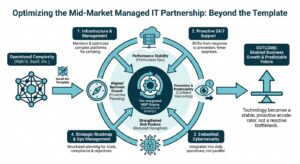
Through structured IT infrastructure management, redundancy planning, and cloud managed services optimization, managed IT services actually reduce the likelihood of disruption. Which leaves you free to concentrate on growth objectives.
Business continuity and disaster recovery planning strengthen your operational resilience. Vendor consolidation simplifies oversight. Predictable service models reduce cost volatility.
It’s like having a control tower overseeing every moving part of your environment – coordinating, monitoring, and intervening before minor issues become collisions.
The net result is that when downtime decreases and security posture strengthens, your leadership team regains its strategic focus.
Growth initiatives – acquisitions, expansion, modernization, even the addition of agentic AI where appropriate in the future – become easier to execute because your technology foundation is stable.

Choosing the Right Managed IT Services Company for Your Organization
Selecting a managed IT services company requires executive scrutiny.
You should assess IT managed services for engineering depth, security integration, mid-market specialization, and cultural alignment.
A managed services provider that primarily serves small organizations may lack the governance rigor required for complex environments in the mid-market arena.
So – ask about cybersecurity managed services integration. Evaluate how they approach IT risk management. Examine reporting structures and executive engagement models.
Red flags often appear in a provider’s overemphasis on “affordable IT support” rather than structured outcomes. Your organization doesn’t need a helpdesk vendor. It needs a strategic partner.
What Success Looks Like With the Right Managed IT Services Partner
With the right managed IT services provider in place, you will find that operational “noise” decreases.
Disruptions become less frequent. Security posture strengthens measurably. Compliance becomes structured rather than reactive. And your leadership team gains visibility into IT performance and risk exposure.
Most importantly, your growth strategy is no longer constrained by technology instability.
Managed IT support, when executed strategically, protects your existing operations and enables your next phase of expansion.
Katalyst – A Security-First Managed IT Services Provider for Mid-Market Organizations
At Katalyst, we approach managed IT services with a security-first, engineering-led mindset. We’re vendor-agnostic, so we answer only to your needs. We don’t do generic.
As a managed IT services provider focused on mid-market organizations, we integrate managed IT security services, proactive managed IT support, and structured governance into a cohesive framework that works for you.
Our objective is not simply to give you operational stability. We partner with you to bring long-term cyber resilience and measurable growth enablement.
If you’re evaluating your current IT model – or planning your next stage of expansion – schedule a strategic consultation with Katalyst to assess how your current IT model aligns with your growth and risk objectives.